Tuesday, June 30, 2015

Beyond Digital Natives

Chapter 10
"Very young children show expertise in on-screen reading, even where homes have no computers."
I like this quote because a lot of households don't have a computer, but they do have other devices that have screens.  I would think there are more devices such as iPhones, iPads, or tablets in homes than actual computers.  Children learn on touch screen devices just as well, if not better than, they learn on computers.  

-Bearne et al. (2007, p. 11) 
As cited in Thomas, 2011 p. 151

Chapter 11
"Another effect of the wider debate, related to but distinct from the digital native argument, has been to amplify the argument that emerging technologies are changing society in ways that education needs to account for."
I agree and disagree with this quote.  I feel that educators should have some of the responsibility of teaching students about technologies; however, educators should not be responsible for teaching every technology.  We, as educators, should not teach our students how to use social media, instead we should educate students on how to safely navigate and search for information using the internet.  Education involving reading, writing, and mathematics should begin at home (we hope), why should technology education be different?  More and more responsibilities are landing on the shoulders of the educator, from manners and character education to content and now, technology.

-Thomas, 2011, p. 177

Chapter 12 
"We identify digital natives as a population, and not a generation, of young people who use technology in relatively advanced ways."
-Thomas, 2011, p. 188

This quote really stood out to me.  I really like the use of the word population instead of generation to define a digital native.  Using the word population instead of generation, implies that not all young people use technology in advanced ways; which I agree with.  We have learned throughout the text that not all young people have the same access to technology and therefore, will not have the same digital knowledge.

I really never thought of the term digital literacy before this text.  To me, someone who is literate is a person who can read or write, or an educated person.  A digital literate person would then be a person who is educated in the digital world; anyone, not just the "digital natives."  Digital native was another term i had never heard of before this text.  I do not agree with the use of this term to define a generation; I don't agree with any term used to define and entire generation, for that matter.  The quote I chose from chapter 12 sums up my feelings about digital natives; "We identify digital natives as a population, and not a generation, of young people who use technology in relatively advanced ways" (Thomas, 211, p. 188).
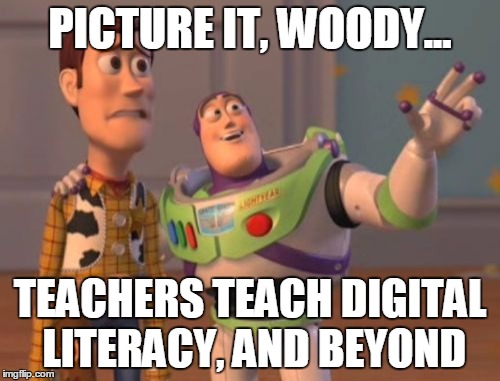

I thought these two characters were good for this Meme because, if you have seen Toy Story, you would know that Buzz is pretty tech savvy and Woody is not.  In this Meme, Buzz is excited and happy that digital literacy will be taught to students.  The look on Woody's face is a little more of panic than excitement because he is not very tech savvy.  


References:
Thomas, M. (2011). Deconstructing Digital Natives: Young People, Technology and the New Literacies. New York, NY: Routledge.

Monday, June 29, 2015

Deconstructing Digital Natives Presentation


My presentation begins by asking the question, “Who are Digital Natives?” There is some debate about the actual definition of the term “digital native” throughout the text. I provide my interpretation of the definition of a "digital native," but I end the definition with a question mark because the definition is questionable.

I target youth internet activity in the next few slides. The youth seem to use the internet more for social means and entertainment rather than political means or seeking information. This is present in different countries as well as in the United States. For example, the internet use by Japan youth is very similar to the internet use of American youth. Although the definition of "digital native" focuses on youth, not all children have access to technology; so not all digital natives are created equal. Even if children grow up surrounded by technology, they have different interests, they all learn in different ways; visual, auditory, kinesthetic, and not all children learn at the same rate.

Digital competence is something you have to continuously learn, and anyone, at any age, can be a life long learner of technology.  Because of this, people who do not fit into the definition of a “digital native” are becoming more competent with technology than those who do fit into the definition!

How should technology and the internet be used; for entertainment (according to youth) or for knowledge (according to adults)? The text coined the term “edutainment,” which is a mixture of both education and entertainment. In other words, more and more entertaining games for young children are beginning to be educational; learning made fun!

The debate is still out on the definition of a “digital native.” The text offers so many different interpretations of what a “digital native” is and who these “digital natives” are; the definition needs to be reconstructed. With this being said, I ended my presentation with a spin on the question that began my presentation, “Who are Digital Natives, REALLY?

References:
Thomas, M. (2011). Deconstructing Digital Natives: Young People, Technology and the New Literacies. New York, NY: Routledge.
Tuesday, June 23, 2015

Digital Natives: Navigating Literate Worlds

Chapter 7
"There is great variation in how digitally competent and technologically interested young people are."
-Ola Erstad
(Thomas, 2011, p.105)

I couldn't agree more with this quote. Young people do not all have the same interests in life, so it should make sense that they don't have the same interests in technology. When it comes to being competent in the digital world, not everyone has the same access to technology, so not everyone has the same opportunities to learn and become familiar with digital technologies.


Chapter 8
"A critical issue here is that students have an array of tools and services at their fingertips that give them easy access to information, but these same tools that students preference are not optimized to support scholarly information seeking."
-Gregor E. Kennedy and Terry S. Judd
(Thomas, 2011, p. 130)

This quote is slightly confusing to me. If students are not aware of tools available for scholarly information seeking; how should they be expected to know to use them? Students should be guided by their teachers to use the information seeking tools rather than Google or Wikipedia.

Chapter 9
"The study indicated that the skills and attitudes considered as being the most important for participation were actually not rated as the most important among the young people themselves."
-Sheila Zimic and Rolf Dalin
(Thomas, 2011, p. 137)

This quote shows the difference in what adults and young people find important. Younger group used the internet more for social interactions while the older group used it more for political information, travel plans, information about society, looking at maps, price comparison, and email. Young people find it more important to use the internet to stay in contact with friends through social media. Older people find it more important to use the internet for gathering information on different interests.

Teaching Digital Literacy?

According to the text, there are five dimensions, "which highlight different aspects of how we understand digital literacies as part of school-based learning" (Thomas, 2011, p. 110). Those dimensions are basic skills, media as objective analysis, knowledge building in subject domains, learning strategies, and digital Bildung/cultural competence. I agree with the fact that students should be taught these five dimensions in school. If technology is integrated into lessons, and used to enhance learning I feel as though it should also be taught to the students.


I feel that the development of digital literacies can support the development of academic reading and writing practices. This past year my class read Charlotte's Web, the word "ascend" was used a lot throughout the book. I asked if anyone new what this word meant; one student raised his hand. He proceeded to give the correct definition. When asked how he knew the definition; he said he learned it playing MindCraft. This is one example of how digital literacies support the development of academic reading and writing practices.


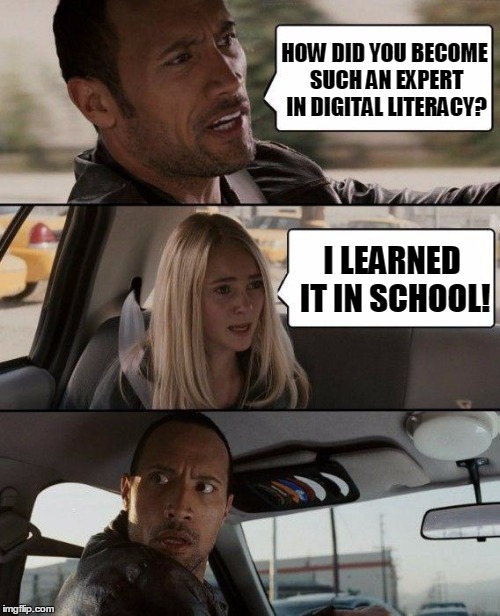
This meme shows an adult's reaction to information about what students are learning in school. I like the facial expression in the last section; a look of disbelief that digital literacy is taught in school.

References:
Thomas, M. (2011). Deconstructing Digital Natives: Young People, Technology and the New Literacies. New York, NY: Routledge.

Wednesday, June 17, 2015

The Civic, Social and Multi Modal Lives of Digital Natives

Chapter 4
"Digital Natives are used to receiving information really fast.  They like to parallel process and multi-task.  They prefer their graphics before their text rather than the opposite.  They prefer random access (like hypertext).  They function best when networked.  They thrive on instant gratification and frequent rewards.  They prefer games to "serious" work."
-(Pensky, 2001a, p.2 as cited in Thomas, 2011, p. 50)

I agree with this quote; however, I wonder if the digital native adapted to the fast-paced technology changes, or if technology adapted to fit the digital native's fast-paced interest in technology.  I chose this quote because it reiterates the generation gap between the old (digital immigrants) and the new (digital natives).  The older generation is more patient than the younger.  I can remember waiting patiently for dial-up internet and not thinking twice about it; now, I get impatient if my internet takes more than a few seconds to load.  


Chapter 5
"Therefore, young people tend to write their own blogs about activity (for example, what they are and what they did during the day) or their feelings (for example, loneliness, happiness, and boredom) with a desire to connect with others, rather than express their political opinions or criticisms:..."
 -Toshie Takahashi
(Thomas, 2011, p. 78)

Although chapter five was titled "Japanese Youth and Mobile Media," a lot of the same issues occur in America.  I see a lot of posts on social media about daily activities or what's for dinner.  In my opinion, there are too many private things being shared for the world to see. Social media postings are like diary entries to some people.  Reading someone's diary, their private thoughts and feelings, is thought of as wrong and disrespectful.  Yet, people share the same thoughts and feelings they would in a diary entry on social media and don't think twice about it.  It is good to know that America isn't the only country doing this.


Chapter 6
"However, we need to be careful with terms such as "Digital Natives" that lead to an understanding of a whole generation as a homogeneous group."
-Mike Levy and Rowan Michael
(Thomas, 2011, p. 83) 
The term "digital native" refers to a large group of people born into the world during the time of technology.  There are students all over the world, in different countries who don't even know how to turn on an electronic device.  On the other hand, there are students all over the world, in all different countries who could teach me a thing or two about the latest technologies; these students more than likely grew up using technology.  Unfortunately, not everyone can afford technology devices; in order to grow up using technology, you need to have the means to buy the technology.  I would re-define the term "digital native" to describe those who have grown up with technology at their fingertips.  


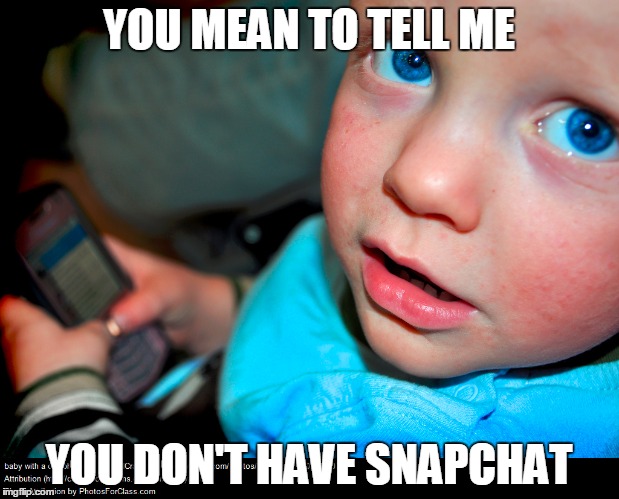
This Meme is innocently poking fun of someone who doesn't have Snap Chat.  The look of worry on the toddler's face is priceless.  It's the same look I get when I tell someone I don't have the latest app; and it's the same look I give someone when they ask if I have an app I've never heard of before.


References:
Thomas, M. (2011). Deconstructing Digital Natives: Young People, Technology and the New Literacies. New York, NY: Routledge.

Wednesday, June 10, 2015

Digital Natives: Reflecting on the Myth

Forward


"Much of young people's use of digital technology is mundane rather than spectacular: it is characterized not by dramatic manifestations of innovation and creativity, but by relatively routine forms of communication and information retrieval."
-David Buckingham
(Thomas, 2011, p. X)

I agree with this quote; however, I do not think it only applies to young people.  The older generation of internet users may also only use it to communicate and retrieve information.  If I were not taking on-line courses to further my education, I would only use the internet for these two purposes.  


Chapter 1

"Though numerous arguments have established a connection between digital natives and their ability to use Web 2.0 technologies, only a limited number have familiarity with the most commonly cited emerging technologies, and even fewer use them frequently."
-Michael Thomas
(Thomas, 2011, p. 7)

This quote correlates with the quote I chose from the Forward section of the book.  To me, the term "Digital Native" means someone who is from the technology era.  I, myself, fall under this category; however, I am not familiar with the latest apps or emerging technologies.  I am even limited in my use of Web 2.0 technologies.


Chapter 2

"The point is that while the need for wise people to discuss, define, compare, and evaluate perspectives is not changing, the means by which they do so and the quality of their efforts are growing more sophisticated because of digital technology.
-Marc Prensky
(Thomas, 2011, p. 21)

I could not agree more with this quote!  We will always need wise people to discuss, define, compare, and evaluate perspectives.  Now, technology has made it easier to communicate. Not only can we value the opinions of those located near us, we can also learn and discuss perspectives from all over the world.

Chapter 3

"Universities are losing their grip on higher learning as the Internet is, inexorably, becoming the dominant infrastructure for knowledge - both as a container and as a global platform for knowledge exchange between people - and as a new generation of students requires a very different model of higher learning."
(Tapscott & Williams, 2010, p. 18) 
as cited in (Thomas, 2011, p. 33)

I agree and disagree with this quote.  While I do feel like the Internet is becoming the dominant infrastructure for knowledge, I do not feel like Universities are losing their grip on higher learning.  Utilizing the Internet is not a substitute for a college education.  Employers are seeking college graduates, not self proclaimed Internet experts.


My Thoughts

I have always thought that technology has had an effect on peoples' abilities to think, learn, and socialize.  Some of those effects are positive and some are negative.  The way we socialize for example; digital natives are "dragging" digital immigrants into the 21st Century by making the digital transition easier.  A negative effect is cyber bullying.  Hiding behind a computer screen and bullying others is all to easy thanks to the anonymity of the Internet. Regardless, technology is here to stay.  


 Digital Native: The Beginning

This picture represents my thoughts on what it means to be a Digital Native.  Children are being introduced to technology at a younger and younger age.  A 5 year old today has more knowledge about technology than I did when I was twice their age, even though we are both considered Digital Natives.  The earlier a child is exposed to new technologies, the more likely they are to adapt to the ever-changing world of technology.


Thomas, M. (2011). Deconstructing Digital Natives: Young People, Technology and the New Literacies. New York, NY: Routledge.

Saturday, June 6, 2015

Digital Effects on Conventional Reading and Writing Practices

There were several quotes that stood out to me in the article Does Digital Media Make Us Bad Writers?.  The beginning of the article was a little confusing, but after reading further, it started making sense.


“There never was a golden age where everybody could write well,” says Lunsford. “Writing is hard.”

I agree with this quote, writing is very hard.  My students struggled with it all year.  It was frustrating as a teacher because they all knew the rules of writing, they just didn't apply those rules when they would write.


"Some of the changes with writing today, Baron says, have little to do with new technology and are more the result of our increasingly less formal society."

I also agree with this quote from the article.  Our society, as a whole, is not as dignified or well-spoken as it once was.  We live in such a fast paced world, and we have everything right at our fingertips; being formal simply takes too long.  It makes sense that in our less formal, fast paced society, writing has been effected.  

I found the second article,Literacy Debate: Online, R U Really Reading?, more interesting than the first. Again, there were several things that stood out to me in this article, but I couldn't agree more with this quote!


"The simplest argument for why children should read in their leisure time is that it makes them better readers."

This past year I taught third grade, and I had several students who read below grade level. I would tell them almost everyday, "the only way to get better at reading, is to practice reading." Just like with a sport or hobby, the only way to get better at anything is to practice. All of my students, (excluding those on IEP's) left third grade reading on level.

I also preached how important it is to continue reading, "if you don't use it, you lose it." Same goes for sports and hobbies. When a person takes a break from a sport or hobby, and then restarts it, they struggle to get back to the same level they were on when they left. Reading is the same way! When a person stops reading for a while (over a summer), they struggle to get back to the same level they were once on. Eventually, if they keep practicing, they will reach that level, if not surpass it.

Web Evangelists Verses Traditionalists  

I feel the continuum between Web Evangelists and Traditionalists is a bit extreme in both directions.  I cannot take a stand on either side, but I will stand somewhere in the middle. Reading is reading, whether it be on the internet or in a book.  It doesn't matter what form of reading children do, the most important thing is that they are reading and will continue reading.


"Some Web evangelists say children should be evaluated for their proficiency on the Internet just as they are tested on their print reading comprehension."

While I do agree with the Web Evangelists on that digital media is changing the way people read and write.  I do not agree with this quote.  I think our children are tested way too much as it is, and to test on internet proficiency is unfair.  It is very difficult to teach technology in a shared computer lab with outdated computers or poor internet connection.

I know in the county I teach, most schools have to schedule days and times for each class to have about 45 minutes (if that) of computer lab time a week.  For some, this is all the time they get using the internet.  Until we can provide every student with a computer and internet access, it is unfair to "evaluate their proficiency on the internet."

"Some traditionalists warn that digital reading is the intellectual equivalent of empty calories."


The comparison of digital reading to empty calories is funny to me. The foods that are considered "empty calories" are usually the most enjoyable to eat. So if we compare digital reading to empty calories using this argument, then digital readings would be the most enjoyable to read.  


It is much easier and enjoyable to read something that interests you.  The older generations would search for interesting things to read at the library, the younger generations search for interesting things to read too, they just search the internet.


Karp, Josh. "Does Digital Media Make Us Bad Writers? | Spotlight on Digital Media and Learning." Does Digital Media Make Us Bad Writers? 26 Jan. 2010. Web. 5 June 2015.

Rich, Motoko. "Literacy Debate: Online, R U Really Reading?" The New York Times. The New York Times, 26 July 2008. Web. 5 June 2015.

Texting and Multi-modal Texts


After watching the TED Talk video above, about the relationship between texting and language, there are some important things I've learned.  The important things I learned from the video are; people talk in word packets of only 7 to 10 words, educators have been worried about the written language for some time, and what pragmatic particles are and why they are used.  But, the most important thing I learned is texting is not the decline of language, in fact it is considered a "new language."


Blabberize could be used to support learning in my classroom by allowing the students to create their own Blabberize video about the subject we are studying.  They could also use this app to practice spelling words, sight words, or vocabulary words.  Elementary school children will think this is funny and will have fun making the pictures talk.