"Very young children show expertise in on-screen reading, even where homes have no computers."
I like this quote because a lot of households don't have a computer, but they do have other devices that have screens. I would think there are more devices such as iPhones, iPads, or tablets in homes than actual computers. Children learn on touch screen devices just as well, if not better than, they learn on computers.
-Bearne et al. (2007, p. 11)
As cited in Thomas, 2011 p. 151
Chapter 11
"Another effect of the wider debate, related to but distinct from the digital native argument, has been to amplify the argument that emerging technologies are changing society in ways that education needs to account for."
I agree and disagree with this quote. I feel that educators should have some of the responsibility of teaching students about technologies; however, educators should not be responsible for teaching every technology. We, as educators, should not teach our students how to use social media, instead we should educate students on how to safely navigate and search for information using the internet. Education involving reading, writing, and mathematics should begin at home (we hope), why should technology education be different? More and more responsibilities are landing on the shoulders of the educator, from manners and character education to content and now, technology.
-Thomas, 2011, p. 177
Chapter 12
"We identify digital natives as a population, and not a generation, of young people who use technology in relatively advanced ways."
-Thomas, 2011, p. 188
This quote really stood out to me. I really like the use of the word population instead of generation to define a digital native. Using the word population instead of generation, implies that not all young people use technology in advanced ways; which I agree with. We have learned throughout the text that not all young people have the same access to technology and therefore, will not have the same digital knowledge.
I really never thought of the term digital literacy before this text. To me, someone who is literate is a person who can read or write, or an educated person. A digital literate person would then be a person who is educated in the digital world; anyone, not just the "digital natives." Digital native was another term i had never heard of before this text. I do not agree with the use of this term to define a generation; I don't agree with any term used to define and entire generation, for that matter. The quote I chose from chapter 12 sums up my feelings about digital natives; "We identify digital natives as a population, and not a generation, of young people who use technology in relatively advanced ways" (Thomas, 211, p. 188).
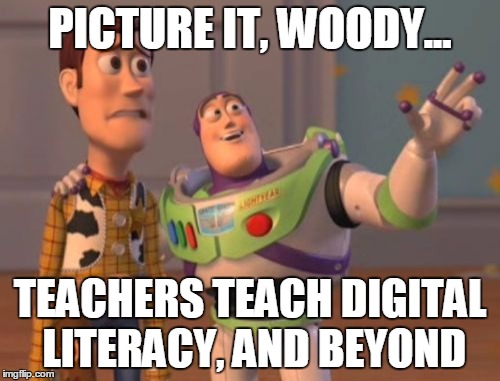
I thought these two characters were good for this Meme because, if you have seen Toy Story, you would know that Buzz is pretty tech savvy and Woody is not. In this Meme, Buzz is excited and happy that digital literacy will be taught to students. The look on Woody's face is a little more of panic than excitement because he is not very tech savvy.
References:
Thomas, M. (2011). Deconstructing Digital Natives: Young People, Technology and the New Literacies. New York, NY: Routledge.

No comments:
Post a Comment