"There is great variation in how digitally competent and technologically interested young people are."
-Ola Erstad
(Thomas, 2011, p.105)
I couldn't agree more with this quote. Young people do not all have the same interests in life, so it should make sense that they don't have the same interests in technology. When it comes to being competent in the digital world, not everyone has the same access to technology, so not everyone has the same opportunities to learn and become familiar with digital technologies.
Chapter 8
"A critical issue here is that students have an array of tools and services at their fingertips that give them easy access to information, but these same tools that students preference are not optimized to support scholarly information seeking."
-Gregor E. Kennedy and Terry S. Judd
(Thomas, 2011, p. 130)
This quote is slightly confusing to me. If students are not aware of tools available for scholarly information seeking; how should they be expected to know to use them? Students should be guided by their teachers to use the information seeking tools rather than Google or Wikipedia.
Chapter 9
This quote shows the difference in what adults and young people find important. Younger group used the internet more for social interactions while the older group used it more for political information, travel plans, information about society, looking at maps, price comparison, and email. Young people find it more important to use the internet to stay in contact with friends through social media. Older people find it more important to use the internet for gathering information on different interests.
Teaching Digital Literacy?
According to the text, there are five dimensions, "which highlight different aspects of how we understand digital literacies as part of school-based learning" (Thomas, 2011, p. 110). Those dimensions are basic skills, media as objective analysis, knowledge building in subject domains, learning strategies, and digital Bildung/cultural competence. I agree with the fact that students should be taught these five dimensions in school. If technology is integrated into lessons, and used to enhance learning I feel as though it should also be taught to the students.
I feel that the development of digital literacies can support the development of academic reading and writing practices. This past year my class read Charlotte's Web, the word "ascend" was used a lot throughout the book. I asked if anyone new what this word meant; one student raised his hand. He proceeded to give the correct definition. When asked how he knew the definition; he said he learned it playing MindCraft. This is one example of how digital literacies support the development of academic reading and writing practices.
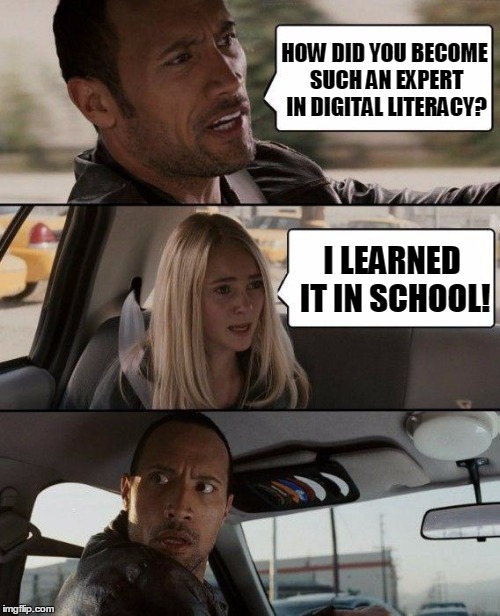
This meme shows an adult's reaction to information about what students are learning in school. I like the facial expression in the last section; a look of disbelief that digital literacy is taught in school.
"The study indicated that the skills and attitudes considered as being the most important for participation were actually not rated as the most important among the young people themselves."
-Sheila Zimic and Rolf Dalin
(Thomas, 2011, p. 137)
Teaching Digital Literacy?
According to the text, there are five dimensions, "which highlight different aspects of how we understand digital literacies as part of school-based learning" (Thomas, 2011, p. 110). Those dimensions are basic skills, media as objective analysis, knowledge building in subject domains, learning strategies, and digital Bildung/cultural competence. I agree with the fact that students should be taught these five dimensions in school. If technology is integrated into lessons, and used to enhance learning I feel as though it should also be taught to the students.
I feel that the development of digital literacies can support the development of academic reading and writing practices. This past year my class read Charlotte's Web, the word "ascend" was used a lot throughout the book. I asked if anyone new what this word meant; one student raised his hand. He proceeded to give the correct definition. When asked how he knew the definition; he said he learned it playing MindCraft. This is one example of how digital literacies support the development of academic reading and writing practices.
References:
Thomas, M. (2011). Deconstructing Digital Natives: Young People, Technology and the New Literacies. New York, NY: Routledge.
We picked very similar quotes from chapter 7 and I think that your thoughts hit the nail on the head. Everyone isn't the same, everyone doesn't have the same interest, and everyone doesn't have the same skills. So people thinking that all digital natives are equal in their abilities is a bad assumption to make.
ReplyDeleteI also definitely agree that students should be taught (in school) how to use and understand the technologies that teachers will be expecting them to use. If not, how can we expect students to learn when not all students have the same learning opportunities at home? (It's crazy to think that they do)
And you meme is great! It is very true now days with what kids are learning about and using in the classroom. Maybe they are talking more about computers, or calculators, or any online educational application at home, and parents are taking notice. The technology kids are using now is definitely different than what their parents used while in school, so a reaction like your meme is very possible!
Kristi - your meme is great and very unique! It shows the reaction that someone may have to hearing that students are being taught HOW to use the internet as they were discussing in our text. I also liked your first quote and reaction. I see generalization of young people's digital competency a lot and it bothers me. Not all students are arriving at school with the same technological background or skills.
ReplyDeleteYour meme is too funny. I remember when I was in school, my parents or grandparents would always ask me what I learned in school, and I said " I don't know." I feel if I had been interested in what was being taught I would've told them. I think meeting students interests in learning in what they already do would make a big difference. Also your quote from chapter 8 resonates with me. I mentioned the same thing we need to educate students on scholarly sites to use. I had this experience in school, I was told which sites not to use, but not which ones to use.
ReplyDeleteI laughed so hard at your meme. It's great! And very accurate. The technology available today is just completely different from what a lot of adults are used to. Everything now isn't just about operating PowerPoint or searching for an article on Google. If a child came home and told their parents they got to use their cell phones for an assignment in class, I think their face would look very similar to that.
ReplyDeleteKristi,
ReplyDeleteI loved your Meme and I think that people really do have that reaction! I completely agree with your quote from chapter 7, everyone has different interests so of course they are going to like different technology tools as well. We all use technology differently. Some use it for interaction and communication while others may use it to find information and political cases. I think that it is our job as educators to help teach our students how to become digital literate and by doing that we need to keep up with technology as well.
The quote from chapter 7 was by far the most interesting to me. There is a large variance between what sparks people to become interested in technology. For some it might even lead to a lack of interest in technology. I do love The Rock and your meme gets your teaching digital literacy message across.
ReplyDeleteKristi,
ReplyDeleteYour reactions to the quotes are thoughtful because yes, not everyone has the same access to all the new technological tools, so how can everyone be on the same learning page?
It's a tough question, and also digital literacy should be in schools for all students to learn but especially for the children who do not have access in their home life. They will need the knowledge for the workforce just like the other children. That brings me to your meme-- hilarious! Parents truly must not be aware necessarily where their kids are just grasping these new concepts because digital literacy was never taught in schools. It's a great subject!